
The Curious Rise of Utah's Dirty Soda: From Desert Drive-Thrus to a National Obsession
How an obscure southern Utah kiosk, a 19th-century religious health code, and a bitter federal trademark battle spawned America’s fastest-growing mocktail subculture.
The St. George Genesis: April 2010
In the spring of 2010, Nicole Tanner and her husband Todd stood in a windswept parking lot in St. George, Utah. Todd had survived a bout with testicular cancer, leaving the family buried under hundreds of thousands of dollars in medical debt. Brainstorming small-business ideas that required minimal overhead, Todd observed that while the Pacific Northwest had espresso drive-thrus on every street corner, Southern Utah had scorching 105-degree summer days and zero drive-thrus catering to cold, custom-infused drinks.
They scraped together their savings, leased a tiny 90-square-foot kiosk, and christened it Swig. Their premise was deceptively simple: deliver fountain drinks customized with coffeehouse flavored syrups and real fruit purées, handed out alongside chilled, soft-baked sugar cookies topped with signature pink almond frosting.
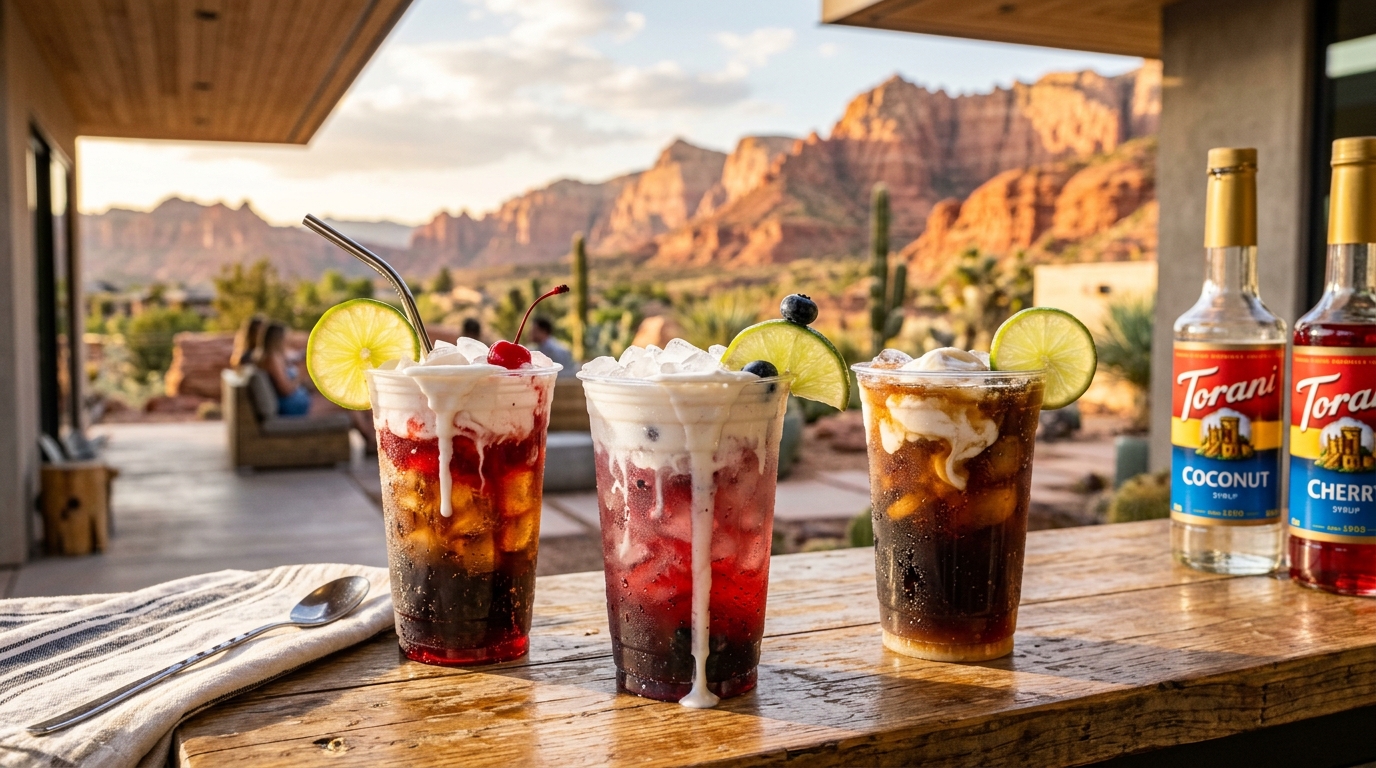
The defining moment arrived when a regular requested coconut syrup and a wedge of fresh lime in their 32-ounce Dr. Pepper, finished with a heavy splash of sweet half-and-half. Swig put it on their board as "getting your soda dirty." Almost overnight, double drive-thru lines backed out onto St. George Boulevard, blocking local traffic and forcing the city to request traffic-control plans.
The 'Word of Wisdom' & The Utah Coffee Substitute
To understand why dirty soda became a regional religion rather than a passing food fad, one must understand Utah’s unique demographics. Approximately half of Utah's population belongs to The Church of Jesus Christ of Latter-day Saints (frequently referred to as LDS or Mormons).
LDS doctrine includes the Word of Wisdom, a health revelation first penned in 1833 that advises against the consumption of alcohol, tobacco, and "hot drinks." In church tradition, "hot drinks" was universally codified as brewed coffee and tea (black and green). Crucially, however, cold fountain soda was never explicitly forbidden.
In August 2012, church headquarters issued an official public statement clarifying that church health guidelines do not prohibit caffeinated soft drinks. For hundreds of thousands of active church members, the moral ambiguity evaporated.
In secular American life, coffee shops serve as what sociologist Ray Oldenburg coined the "third place"—an anchor of community life distinct from home and work. Coffee shops host morning catch-ups, business pitches, and study sessions; bars host evening unwinding. In Utah, where coffee and alcohol were largely off the table for the religious majority, dirty soda drive-thrus filled the exact same sociological void.
At 2:00 PM on any given Tuesday, drive-thru lanes from Logan to St. George are jammed with high school students, minivan carpools, and remote tech workers ordering complex, hyper-personalized refreshments. Custom soda became Utah's cocktail hour.
The Wasatch 'Soda Wars': Swig vs. Sodalicious
With Swig’s explosive popularity, rival entrepreneurs quickly took note. In 2013, Kevin and Shannon Auernig launched Sodalicious in Provo, near the campus of Brigham Young University. Sodalicious leaned into cheeky, irreverent drink names like "Second Wife" (Mountain Dew, blood orange, mango), "Your Mom" (Dr. Pepper, coconut, blackberry), and "Naughty Boy" (Pepsi, coconut, vanilla).
In April 2015, the friendly rivalry turned into a high-stakes legal feud. Swig filed a federal trademark infringement lawsuit against Sodalicious in U.S. District Court in Salt Lake City, claiming ownership over the registered trademark for the word "DIRTY" as applied to beverages, as well as accusing Sodalicious of copying their frosted pink cookie recipe and oval logo style.
The lawsuit captivated Utah media for over two years:
- Sodalicious launched counter-campaigns handing out bumper stickers proclaiming "Keep Soda Dirty" and arguing "dirty" was a generic bartending term (like a dirty martini).
- Customers took fierce sides, refusing to cross tribal lines—Swig devotees vs. Sodalicious purists became Utah Valley’s version of Coke vs. Pepsi.
- In November 2017, after millions spent in legal fees, both parties signed an amicable, confidential settlement allowing both brands to thrive and expand.
September 2017: BYU's Great Caffeine Uprising
For nearly sixty years, Brigham Young University—the flagship university of the LDS Church with over 30,000 students in Provo—refused to sell caffeinated beverages on campus. While students could bring in outside cans, campus dining halls, vending machines, and athletic concession stands only dispensed caffeine-free Coke, Sprite, and Barq's root beer.
On September 21, 2017, BYU Dining Services quietly tweeted: "It’s happening. Caffeinated Coke is now available on campus."
The reaction on campus was ecstatic. Lines stretched out the doors of the Wilkinson Student Center as students celebrated what became popularly known as "Caffeine Day." The policy change cemented custom dirty soda mixology as an indispensable staple of collegiate student life along the Wasatch Front.
TikTok Virality, Pop Stars & Sonic Drive-In
In 2021, dirty soda broke through the Utah state border onto the global stage. Utah lifestyle creators on TikTok (part of the viral "MomTok" cultural wave) began filming their daily drive-thru runs, showcasing pastel cups layered with deep mahogany colas and snow-white sweet cream cascades.
The tipping point arrived when pop sensation Olivia Rodrigo posted an Instagram photo holding a massive cup from a Salt Lake City Swig, proclaiming her love for the drink. The video racked up tens of millions of views, igniting a viral wave of copycat recipes from New York to London.
By 2023, national fast-food titan Sonic Drive-In officially launched a nationwide "Dirty Soda" platform, offering to "make it dirty" with coconut, cream, and lime across its 3,500+ locations. Private equity groups poured tens of millions into Swig, Fiiz, and Sodalicious, opening locations across Texas, Arizona, Idaho, Tennessee, and the Midwest.
The Chemistry: Why Doesn't the Cream Curdle?
Every kitchen chemist knows that mixing dairy with acid is usually a recipe for disaster. Colas, citrus sodas, and Mountain Dew have a pH ranging from 2.5 to 3.2 due to phosphoric, citric, and malic acids. Under normal conditions, pouring dairy into liquid this acidic causes the casein proteins to instantly destabilize, coagulate, and float in unpalatable curdled clumps.
So how do professional dirty soda baristas create that velvety, marble-swirled dream drink? The secret lies in three fundamental biochemical principles:
Butterfat Protection
Low-fat dairy (skim, 1%, or 2%) has too little fat to insulate the casein micelles. High-butterfat dairy (sweet half-and-half with 12–18% milkfat, or heavy cream at 36%) forms a protective lipid lipid shield around proteins, preventing hydrogen ions from triggering coagulation.
Kinetic Shock Drop
Crushed nugget or pebble ice has exponentially more surface area than solid cubes. It drops the liquid temperature to near 32°F in fractions of a second. At near-freezing temperatures, the thermodynamic reaction rate of protein denaturation slows to a virtual standstill.
Density Layering
Heavy sweet creams have a lower density than sugar-dense syrup sodas, allowing the cream to gently float on top and create an emulsion barrier. Gently sipping through a straw draws the carbonation up through the creamy cap without violently agitating the liquid.
The Golden Home Mixology Formula
Want to recreate authentic drive-thru dirty sodas in your own kitchen? Memorize this exact four-step order of operations:
- Ice First (Sonic Style): Fill your cup 3/4 full with crushed nugget or pebble ice. Never add ice after liquid—it causes foaming and blows out carbonation.
- Syrup directly on Ice: Add 1 to 2 pumps (1/2 oz to 1 oz) of high-grade syrup (Torani, Monin) over the ice. The ice will chill and slightly cling to the syrup.
- Pour Soda at an Angle: Tilt the cup slightly and pour your cold base soda down the side to preserve crisp carbonation. Leave 1.5 inches of headspace at the top.
- The Float & Squeeze: Squeeze one fresh lime wedge directly over the drink, then gently pour 1 to 1.5 oz of cold sweet cream or coconut creamer across the surface. Do not shake—let it cascade through the pebble ice as you sip!